
Completed in 12 months and four distinctive stages, Goddess is the title of her very first overseas sculpting experience. This work, along with the Rain sculpture, formed the core of her MFA Critical Studies at UCL Slade School of Fine Art. The ever more minimalist progress of this work started with Goddess losing its thick cotton scarf and detailed structure to an ax-chopped brown box wearing nearly no scarf in its second stage of evolution as follows:
Goddess I
This design expresses her feelings towards Middle Eastern women’s traditional clothing, specifically the veil. She made this sculpture for two main reasons: first, in non-Islamic countries, people think that there is some mystery hidden under the veil; she tried to show that there is absolutely nothing; Everything is the same. Second, she expressed her objection to wearing it. She used beautiful handmade paper to cover the waste bin in the middle of her work and put a whirlpool spinning in it to show the struggle of being a woman. This means that on the surface everything must be good-looking and fine but when you take a closer look inside, suddenly it starts moving around. In short, we still have domestic violence and gender inequality in most societies throughout the world; more or less all the same. Using nuts as decorative parts is not far from mocking these beliefs. The base dimensions are 1x1x1 meter and it is made of Balsa wood. There is a cylinder 1 meter high and 90 cm in diameter placed in the center, decorated with nuts and carved wood. This installation is made from Balsa wood, handmade paper, glue, and a red ball in half.
Goddess II
Goddess II follows the same path as the first one, but this time she is braver and more forthcoming in confronting these beliefs. She damaged the base and changed the wrapping material from paper to transparent plastic. She filled the halved balls with tomatoes to show her disgust at such a way of living. In this work, there are no decorative objects; instead, there are two bases for the structure. By placing both bases into transparent wrapping, the work seems to feel lighter than before. The earlier whirlpool spin technique is no longer effective, so this time the drum is filled with trash, without the need to justify its purpose. The base dimensions are 1x1x1 meter and it is made of Balsa wood. Right at the center, there is a cylinder 1 meter high and 90 cm in diameter. This installation is made from Balsa wood, transparent plastic, glue, and one-half of a red ball filled with tomatoes.
Goddess III & IV
The third stage contained none of the structural elements of the past, as the resurrected Goddess was transformed into a white round barrel filled with crystal clear water so that it could get tipped over to pour out its mud and dirt onto the floor in its fourth and final stage of evolution.
Iconography in Goddess Figurine
Dating back to as early as 3000 BC, the Neolithic civilizations of the Middle East conveyed religious and metaphorical meanings through specific objects or figures, portraying their Gods by sculpting nonhuman or animal figures, i.e., a cow-headed woman was the widely-revered symbol of the Egyptian mother Goddess called “Hathor,” or the famous Egyptian sun God “Ra” was hawk-headed. Iconography has been traced back to monotheistic religions such as Christianity as well when the fish and the dove were used to symbolize Christ and the Holy Spirit in early Christian art. As such, the preceding religions usually lent out their better-known icons to the forthcoming ones through the rise and fall of civilizations. The astonishing resemblance between some of these obscure symbols leaves almost no room for coincidence, although the next best guess would be the underlying common needs of humans as a whole, regardless of their whereabouts.
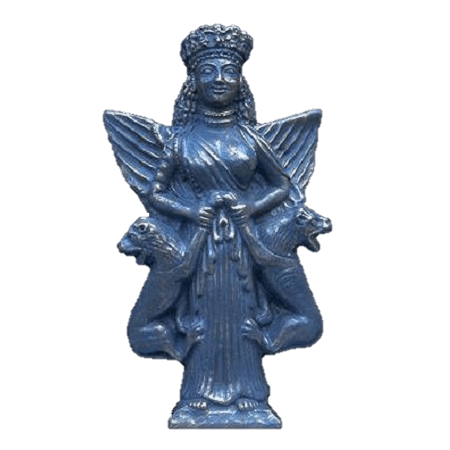
Anahita – the Deity of Water, Fertility, Healing, and Wisdom: Aredvi Sura Anahita, or Anahita, is the oldest Iranian Goddess known to historians and archaeologists. She was often shown wearing a golden scarf, square gold earrings, and a jeweled headdress, wrapped in a larger-than-life golden veil made of thirty otter skins. Anahita was sometimes depicted as driving a chariot drawn by four horses, representing wind, rain, clouds, and hail. She was so revered that the following verse is dedicated to describing her in Avesta – the holy book of Zoroastrians:
“Who makes the seed of all males pure, who makes the womb of all females pure for bringing forth, who makes all females bring forth in safety, who puts milk into the breasts of all females in the right measure and the right quality.” – Avesta
Anahita’s myth originated in Babylon. Egyptians also worshiped their own version of the Goddess of rain called Tefnut. The Greeks’ account of this Babylonian myth manifested itself in the Goddesses, Athena [associated with Wisdom] and Aphrodite [associated with love and procreation]. In the Roman era, Jupiter was worshiped as the God of rain, thunder, and lightning — a multitasking water God, if you will. Thousands of kilometers away, Aztecs too worshiped some form of rain God called Tlaloc.
My Goddess: Who is she?
Her Goddess is the result of Middle Eastern cultural history, further influenced by the living conditions of women; particularly in Iran, where most of the time its history represents the story of the entire Middle East.
She thinks culture is defined as a form of behavior that is accepted by a group of people; this group can be a family, a tribe, a society, or even a country as a whole. Iran is a multicultural country. It was a vast empire stretching from Egypt to India at one point, battling with its neighboring empires and nations such as the Greeks, Romans, Mongolians, and Arabs throughout history.
These contacts have shaped the cultural diversity of Iran. As an Iranian, she thinks she lives in a country of some united ethnicities which encompasses different costumes, languages, accents, behaviors, beliefs, and colors. She defines her Goddess in a highly individual form. For her, every woman is a Goddess all by herself, so being considered a second gender does not necessarily mean that their role in society cannot be as important as men. While surveying the situation of women throughout history, she came across similar ideas; Robert Braidwood in his book “Mothers” has said that it is because of matriarchy that hominids became human. Also, Evelyn Reed – a prehistoric life scholar — in her book “Woman’s Evolution” notes that women have been the main part of any society throughout the history of mankind, from bringing up children to the development of production tools, as in hunting and farming.
Speaking from a historical perspective, she must stress that she despises how the general public is obsessed with labeling history with chronological divisions: Before Christ (BCE), After Christ (AD), Before Islam/After Islam, and so on, to a point that now we even have a period defined as before and after 9/11. She cannot understand why people do this. When she looks back at history, she wonders how people keep their culture and adapt it to a new religion or regime gradually. For example, Nowruz [the Iranian New Year] has been celebrated for over 3000 years, long after the Islamic Conquest of the Persian Empire [637–651 AD].
In some of her sculptures, she tries to mix the beliefs of Iranians before and after Islam. Also, she comes from the overly-symbolized Middle East, a place blessed with an overabundance of symbolic diversities and those who prefer fiction over facts. For example, they use many proverbs in their everyday conversations, because in contrast with Westerners, direct expression of one’s feelings and beliefs is considered rude. All in all, Eastern cultures seem to be unnecessarily complicated for no obvious reason.
For example, in Goddess [1], the green color used is perceived to be of Islamic origin by most Iranians. Interestingly, Zoroastrians too named each day of the week and color after a certain deity; thus, the Anahita Goddess in Zoroastrianism is associated with green candles and Friday. In her work, she used the green veil to represent this very idea.
Another example of how she reflects a strong sense of individualism in her works is that she chose to build her first Goddess from light materials such as Balsa and handmade papers. She tries to show how a woman can be laid-back, calm, and tranquil. For her base, on the contrary, she tried to make something physically heavy, strong, and impatient. Throughout history and up to this point in time, women’s situation has been rather catastrophic as a whole. Moreover, if there were any negative changes in any given society, women were affected first. By putting a drum in the base with a whirlpool inside it, she intended to emphasize that women have often been deprived of stability in their lives as if they are made to worry about everything; i.e., how to manage their life, be independent or to be considered independent. The cubes covered with nuts at each corner are symbols of fertility.